The "Silent CV" Strategy: Land International Jobs from Ghana
Tired of LinkedIn rejections? Discover the "Silent CV" strategy—a proven method for Ghanaian professionals to land high-paying international remote job offers.
By Obed Avorlenu · · Updated July 12, 2026 · 8 min read
The Old Way is Broken
Let me paint you a picture.
You wake up. You open LinkedIn. You scroll through 50 job postings. You apply to 10 of them. You attach your CV. You write a cover letter. You hit submit.

Then nothing.
A week passes. Then two. You check your email obsessively. You refresh your LinkedIn messages. Nothing. Not even a rejection email.
You try again. Another 10 applications. Another week of silence.
Sound familiar?
Here is the hard truth: Traditional job applications are broken. Every remote job on LinkedIn has 500+ applicants. Your CV gets lost in a sea of noise. The hiring manager never sees it. The ATS (Applicant Tracking System) filters it out before a human even lays eyes on it.
But there is a different way.
There is a strategy that Ghanaian professionals are using to skip the queue entirely. It is called the "Silent CV" strategy. You do not apply to any job. Instead, you make yourself so visible to hiring managers that they come to you.
Here is exactly how it works.

The Brutal Reality of Job Applications
Let me share some numbers with you that will change how you think about job hunting.
Fact 1: Over 75% of CVs are rejected by Applicant Tracking Systems before a human sees them. If your CV does not have the right keywords, it does not exist.
Fact 2: The average corporate job posting receives over 250 applications in the first 24 hours. By day three, that number is over 500. Your chances of being noticed? Less than 0.2%.
Fact 3: Over 70% of jobs are never posted publicly. They are filled through referrals, internal hiring, or direct outreach. The jobs you see on LinkedIn are the scraps.
Fact 4: Hiring managers spend an average of 6-8 seconds reviewing a CV. If you do not grab their attention in that time, you are out.
Here is what this means for you: If you are only applying to jobs on LinkedIn, you are competing against hundreds of people for scraps. You are hoping to win a lottery. And the odds are against you.
But here is the good news: There is another way.
Most job seekers do not reach out to hiring managers directly. Most job seekers do not create content that attracts recruiters. Most job seekers do not position themselves as experts before they even apply.
You are about to become one of the few who does.

Step 1: Optimize Your LinkedIn Profile Like a Magnet
Your LinkedIn profile is not a CV. It is a landing page. It is your digital storefront. And if it is not optimized, no one is walking through the door.
Action 1: Use the right keywords.
Hiring managers search for specific keywords when looking for candidates. If your profile does not contain those keywords, you are invisible.
Go to LinkedIn and search for the role you want (e.g., "Remote Customer Support Manager").
Look at 5-10 job postings from different companies.
Write down every keyword that appears in the requirements and responsibilities.
Add those keywords to your headline, summary, and experience sections.
Action 2: Write a headline that sells, not just describes.
Bad headline: "Customer Support Specialist at XYZ Company."
Good headline: "Customer Support Specialist | Helping SaaS Companies Improve Retention by 40% | Remote Worker in GMT+0"
Action 3: Turn on "Open to Work" — but privately.
You want recruiters to know you are open to opportunities, but you do not want your current employer to see it. Use LinkedIn's "Open to Work" feature in private mode.
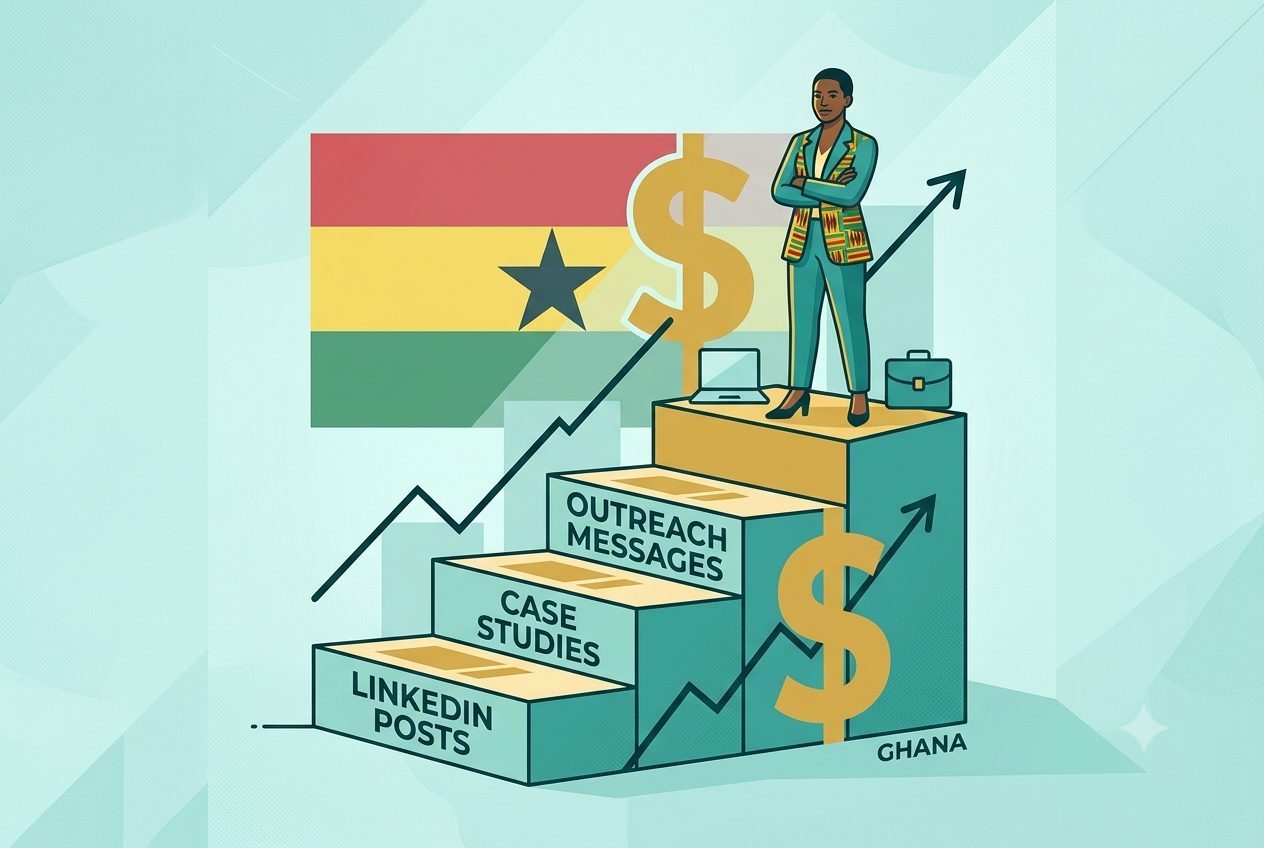
Action 4: Post content twice a week.
This is the "silent" part of the strategy. Do not just wait for jobs. Create content that shows you know your stuff.
Share an insight about your industry.
Comment on a relevant news article.
Write a 2-3 sentence post about a problem you solved at work.
Share a lesson you learned.
Pro tip: The LinkedIn algorithm rewards consistency. Post twice a week for 30 days. Recruiters will start noticing you.
Step 2: Build a Portfolio of Problem-Solving
This is the game-changer that most job seekers completely ignore.
Action 1: Create a 2-page case study.
You do not need to have worked at a big company to do this. Pick a fictional company or a real small business. For example, if you want a job in marketing, create a case study on how you would run a marketing campaign for a local Ghanaian business.
Write 1 page on "The Problem" they are facing.
Write 1 page on "My Solution" and how you would execute it.
Add 1 page of "Expected Results" with numbers.
Action 2: Create a Loom video.
Record yourself walking through your case study using Loom. Talk for 5-7 minutes. Show your face. Show your personality.
Action 3: Create a free website or portfolio.
Use Canva or Google Sites to create a simple one-page portfolio. Include:
Your LinkedIn profile link
Your 2-page case study
Your Loom video
A contact form
Pro tip: When a recruiter asks, "Do you have experience?" you can say, "I do not have formal experience, but I have a case study showing how I would approach this role. Would you like to see it?" This immediately sets you apart.
Step 3: The Outreach Campaign — Reach Out Directly
Stop applying to job postings. Start reaching out to hiring managers directly.
Action 1: Find the hiring manager.
Go to the company's LinkedIn page.
Click "People."
Search for "Head of Operations," "VP of Sales," "Customer Support Manager," or "Recruiter."
Find the person who would be your boss.
Action 2: Send a personalized message.
Do not send a generic "I am interested in working at your company" message. Send something specific.
Template:
"Hi [Name],
I noticed that [Company Name] is [expanding into new markets / launching a new product / hiring for remote roles]. I am a [Your Job Title] based in Ghana with experience in [Your Skill].
I have attached a 2-page case study showing how I would approach the [Specific Role] role in your company. I would love to hop on a 15-minute call to share my ideas.
Would you have time this week?
Best,
[Your Name]"
Action 3: Follow up strategically.
If you do not hear back in 5 days, send a follow-up:
"Hi [Name], I know you are busy. I just wanted to follow up on my email. I have attached a short Loom video where I walk through my case study in more detail. Please let me know if you have 10 minutes to chat."
Action 4: Use WhatsApp if they are in Africa.
Many Ghanaian recruiters and hiring managers are active on WhatsApp. If you find their number, send a brief, professional message. Keep it short and to the point.
Step 4: The 30-Day Action Plan
Here is your exact 30-day roadmap to make this strategy work.
Day 1: Update your LinkedIn headline. Add 10 keywords from job postings. Turn on "Open to Work" in private mode.
Day 2: Post one LinkedIn post about a work lesson. Comment on 3 industry posts.
Day 3: Create a 2-page case study.
Day 4: Record a 5-minute Loom video walking through your case study.
Day 5: Create a free portfolio using Canva or Google Sites.
Day 6: Find 10 companies you want to work for and identify the hiring manager for each.
Day 7: Send outreach messages to 5 hiring managers.
Day 8-29: Post on LinkedIn twice a week. Send outreach messages to 5 new hiring managers every week. Follow up with anyone who has not responded after 5 days.
Day 30: Review your results. If you have had 3 conversations, celebrate. If not, double your outreach.

African Context Tips (Ghana)
Internet is a challenge: When recording Loom videos or attending video interviews, use a stable connection. Test your connection before any important call. Use a wired connection if possible.
Time zone is an advantage: Ghana is GMT+0, which aligns perfectly with the UK and Europe. Use this as a selling point.
Mobile money is your friend: When you get paid, use MTN MoMo, Telecel Cash, or AT Money to receive your salary. For international payments, use Payoneer or Wise.
Power outages are real: Keep your laptop charged. Invest in a power bank. Have a backup plan for power cuts.
Local platforms matter: Consider JobsInGhana and GhanaWeb Jobs as stepping stones.
Language is an advantage: Ghanaians are known for excellent English. Highlight this.
Internet costs money: Budget for data. Treat it as a business expense.
Hard Truth / Reality Check:
The "Silent CV" strategy is not a quick fix. It requires consistency. But here is the thing: Most people will not do this. Most people will keep applying to jobs and hoping for the best. That is why you will win. International jobs pay 5-10x what local jobs pay. And you will never have to play the application lottery again.
Call to Action:
You have two choices today.
Keep applying to jobs the old way.
Try the "Silent CV" strategy.
Here is your one specific action for today:
Open a new tab and go to LinkedIn.
Update your headline. Copy and paste this: "[Your Role] | Helping [Industry] [Solve Problem] | Remote Worker in GMT+0"
Search for a desired role.
Write down 5 keywords from the job postings.
Add those keywords to your profile.
Post one sentence about a lesson you learned at work.
Do this today, and you are already ahead of 90% of job seekers. Go find it.