Survive Inflation in Africa: Budgeting Tips
Learn how to build a budget that withstands inflation in Nigeria, Ghana & Kenya. Discover expert tips and strategies to protect your finances. Read now and stay ahead of rising costs!
By Obed Avorlenu · · Updated July 20, 2026 · 8 min read

⚠️ IMPORTANT DISCLAIMER
This guide is for educational and informational purposes only. Inflation rates, prices, and economic conditions are subject to change. Always verify current rates and adjust your budget accordingly. The author and VectricEarn are not responsible for any financial losses. This is not financial advice.
The Inflation Reality Across Africa
Inflation is not a distant economic concept. It is the reason your grocery bill is higher this month than last. It is why your salary feels smaller every year.
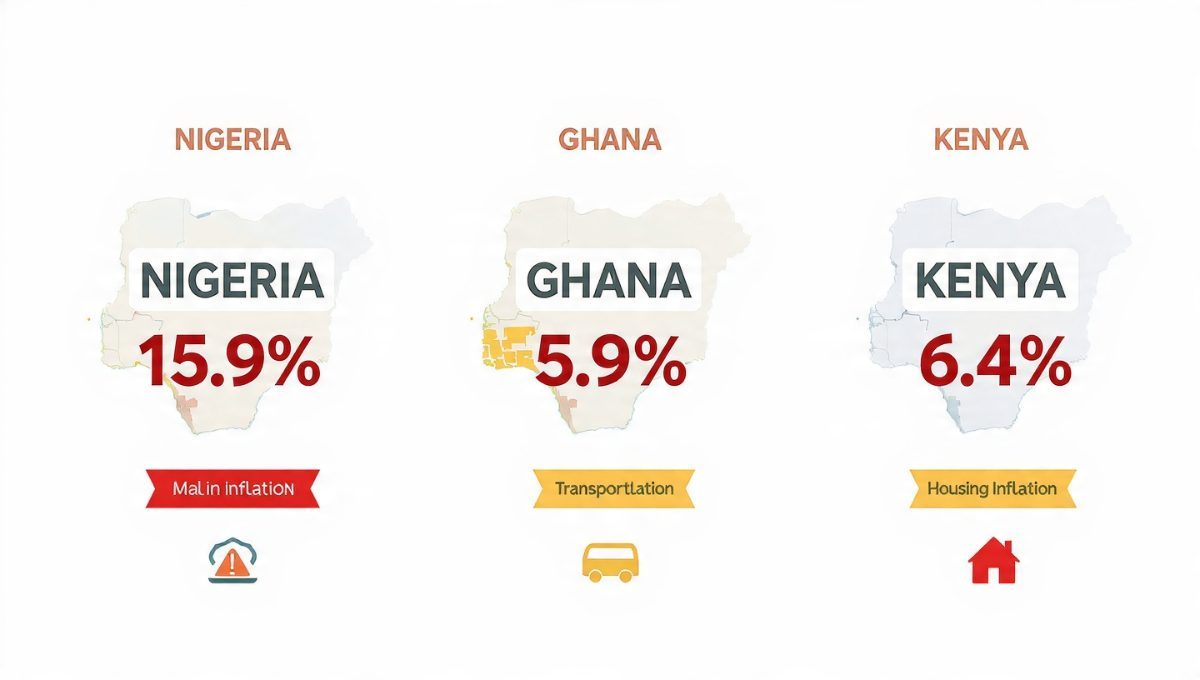
The IMF projects consumer price increases of 15.5% for Nigeria, 5.8% for Ghana, and 5.9% for Kenya in 2026. But these are averages — your actual experience is likely worse.
"When macroeconomic numbers fail to tell the whole story, look at your grocery receipt. That is where real-world inflation lives."
Country-by-Country Breakdown
🇳🇬 Nigeria: The 16% Reality Check
Nigeria's headline inflation stood at 15.93% in May 2026. Analysts project it will hover around 15.8% to 15.95% in June.
The real story is food. Food inflation climbed to 16.96% in May 2026, staying above headline inflation for the second consecutive month. In five months, food inflation surged from 8.89% in January to 16.96% in May — an increase of about 90.8%. Food alone contributed 6.38 percentage points to headline inflation, roughly 40% of total inflation.
What this means for your wallet:
Your food budget needs to be at least 17% higher than last year just to buy the exact same items.
Staple foods like onions, tomatoes, maize, and cassava are driving the sharpest increases.
In 21 states, food inflation is soaring well above 17%.
The IMF notes that higher global fuel, food, and fertilizer prices are worsening poverty and food insecurity. The Central Bank of Nigeria has revised its average inflation forecast for 2026 upward to 15.5% from an earlier estimate of 12%.
🇬🇭 Ghana: 5.3% and Rising
Ghana's inflation rate rose to 5.3% in June 2026, up from 3.7% in May — marking the third consecutive monthly increase.
Non-food inflation climbed to 6.3% from 4.1% in May, accounting for 68.5% of headline inflation. Food inflation also rose to 3.9% from 3.3% the previous month. Bus fares, rent, and school fees are the main drivers.
Regionally, the North East Region recorded 10.2% inflation, while the Bono East saw a decline of -4.4%.
What this means for your wallet:
Non-food costs (rent, transport, school fees) are currently rising faster than food.
Services inflation stands at a heavy 9.4%.
Inflation for locally produced goods rose to 6.7%.
🇰🇪 Kenya: 6.4% with Food and Transport Pressure
Kenya's inflation eased slightly to 6.4% in June 2026, down from 6.7% in May. But the pressure on households remains incredibly significant.
Food inflation stood at 8.6% year-on-year. The food index increased by 8.6% over the past year and remains the single largest contributor to overall inflation, accounting for 2.5 percentage points. Items like kale (sukuma wiki) rose 4.0%, spinach rose 3.1%, and loose maize grain rose 1.2%.
Transport costs recorded the sharpest annual increase at 16.1% despite a decline in fuel prices. Housing, water, electricity, and gas rose 3.4%.
Core inflation (excluding volatile food and fuel prices) eased slightly to 3.1%, but non-core inflation remained elevated at 15.1%.
The World Bank estimates that Kenya's poverty rate could rise by 2 to 4.5 percentage points in 2026, leaving an additional 1 million to 2.4 million people unable to afford even Sh387 ($3) a day.
The Core Strategy: The Anti-Inflation Budget
A traditional budget assumes prices stay stable. In 2026, that assumption is dead. Here is the strategy that actually works.
Step 1: Track Every Single Naira / Cedi / Shilling
You cannot fix what you do not measure.
Action:
Open a notes app or a spreadsheet.
For 7 days, write down EVERYTHING you spend.
Include airtime, transport, food, subscriptions — everything.
At the end of the week, categorise your spending.
Category Examples:
Food (groceries, eating out)
Transport (fuel, buses, ride-hailing)
Housing (rent, utilities, maintenance)
Personal (airtime, data, subscriptions)
Savings & Debt
Miscellaneous
Pro Tip: Use a budgeting app like Monefy, Spendee, or Goodbudget to automate and streamline your tracking.
Step 2: The 50-30-20 Rule (Inflation Adjusted)
The traditional 50-30-20 rule (50% needs, 30% wants, 20% savings) does not work when inflation is in double digits.
Your Adjusted Rule:
60-65% Needs (up from 50%)
15-20% Wants (down from 30%)
15-20% Savings (aiming to protect this margin)
Why: Inflation hits needs hardest — food, transport, housing. You must intentionally allocate more of your share to survival expenses.
Action:
Calculate your monthly income (after tax).
Multiply by 0.65 for Needs.
Multiply by 0.20 for Wants.
Multiply by 0.15 for Savings.
Step 3: The "Essentials First" System
Most people pay bills, then spend, and then try to save whatever is left. That is completely backwards.
The Correct Order:
Savings/Investment — Pay yourself first (15-20%)
Essential Bills — Rent, utilities, debt payments
Food — Groceries only (not eating out)
Transport — Essential travel only
Everything else — What is left
Action:
Set up an automatic transfer to your savings account on payday.
Pay your rent and utilities immediately.
Buy your core groceries in bulk.
Whatever is left is your actual discretionary spending.

Country-Specific Survival Strategies
🇳🇬 Nigeria: Food Is Your Biggest Battle
The Problem: Food inflation has surged 90.8% in just five months. Food accounts for 40% of total inflation. Your food budget needs to be at least 17% higher than last year.
The Strategy:
Buy in Bulk with a Group: Join or start a bulk buying group with neighbours or family. Buy staples like rice, beans, garri, and oil in bulk. Split the costs and save up to 20-30%.
Replace Imported Staples: Imported rice is incredibly expensive. Switch to local rice varieties. Replace wheat flour with cassava flour and use local alternatives where possible.
Shop at Open Markets, Not Supermarkets: Open markets are 20-40% cheaper for fresh produce. Buy directly from traders and go early in the morning for the best prices.
Reduce Transport Costs: Carpool or use public transport. Negotiate fuel costs if you drive, and consider walking for shorter distances.
Use MTN/Airtel/Glo Data Strategically: 10GB monthly bundles are ₦5,000. Minimize background data, use public/office Wi-Fi where available, and download content when on Wi-Fi.
The CBN has increased its inflation forecast to 15.5% for 2026. Plan for prices to stay elevated.
🇬🇭 Ghana: Non-Food Cos

ts Are Rising Fast
The Problem: Non-food inflation is at 6.3%. Rent, school fees, and bus fares are the main drivers. Services inflation stands at 9.4%.
The Strategy:
Lock in Your Rent: If you are renting, negotiate a longer lease with a fixed rate. Landlords are raising rents aggressively; a 2-year lease protects your cash flow. Consider moving to a cheaper area if your rent increases by more than 15%.
Reduce Transport Costs: Ghana's bus fares are rising — use trotro strategically. Carpool with colleagues and neighbours, and negotiate fuel costs if you drive.
Cut Non-Essential Services: Review your subscriptions (DStv, Netflix, data plans). Cancel what you do not use and switch to cheaper alternatives.
Buy Local: Locally produced goods have 6.7% inflation vs 2.3% for imported. Compare prices before buying — imported goods are actually cheaper in some specific categories.
Shop in Bulk at Makola: Market prices are significantly lower than supermarkets. Buy staples in bulk and split the costs with neighbours.
Use MTN MoMo or Telecel Cash Strategically: Mobile money charges 1.5% + GH¢0.50 (capped at GH¢5.00). Plan your transactions to minimise these fees.
🇰🇪 Kenya: Transport and Food Are Your Biggest Bills
The Problem: Transport inflation is 16.1%. Food inflation is 8.6%. Together, they account for over 4 percentage points of total inflation.
The Strategy:
Reduce Transport Costs Aggressively: Transport is your fastest-growing expense. Carpool or use matatus strategically. Negotiate fuel costs if you drive, walk shorter distances, and use M-Pesa to pay for transport where discounts apply.
The Food Strategy: While sukuma wiki, spinach, and maize grain prices are rising, tomatoes and beans have become slightly cheaper. Adjust your shopping list weekly to accommodate these shifts. Buy in bulk with neighbours and shop at open markets rather than supermarkets.
Reduce Electricity Costs: Electricity costs eased slightly in June. Use energy-efficient appliances, turn off lights and electronics when not in use, and consider solar alternatives.
Use M-Pesa Strategically: M-Pesa is the backbone of Kenyan payments. Plan your transactions to minimise fee brackets. Use M-Pesa's savings products (like M-Shwari) for small, liquid amounts.
The World Bank Warning: Poverty could rise by 2-4.5 percentage points. An additional 1-2.4 million people may struggle to afford Sh387 ($3) a day. Plan heavily for potential income shocks by building an emergency cushion.

The 30-Day Inflation-Proof Budget Plan
Week 1: Track and Categorise
Track every expense for 7 days.
Categorise spending (Food, Transport, Housing, etc.).
Identify your top 3 spending categories.
Week 2: Cut and Replace
Identify 3 things you can cut completely.
Identify 3 things you can replace with cheaper alternatives.
Reduce discretionary spending by 20%.
Week 3: Negotiate and Optimise
Negotiate rent or terms if possible.
Review subscriptions and cancel unused ones.
Optimise transport costs (carpool, public transport).
Week 4: Automate and Review
Set up automatic savings transfers.
Automate utility and bill payments.
Review your budget and adjust categories for the next month.
The Hard Truth
"You cannot budget your way out of a severe income crisis, but you can absolutely budget your way out of preventable financial ruin."
Reality Check:
Inflation is not going away soon.
Your salary will not keep up automatically.
You must adapt your spending habits or fall behind.
The strategies above can save you 15-30% on essentials.
Why People Fail:
They do not track their spending consistently.
They cut everything at once, burn out, and then splurge.
They give up after one month.
They do not adjust for specific local inflationary pressures.
The Difference Between Success and Failure:
Success: Track, adjust, and repeat.
Failure: Ignore, hope, and struggle.
Your One Action for Today
Inflation is not going to wait. Neither should you.
Open your phone.
Download a budgeting app (Monefy, Spendee, or Goodbudget).
For 7 days, write down EVERYTHING you spend.
At the end of the week, categorise your spending.
Apply the 60-65-15-20 rule.
Start today. Your future self will thank you.
Last Verified: July 2026