Start Print-on-Demand in South Africa with R500
Start a profitable South African print-on-demand business with just R500. Avoid common pitfalls, use local suppliers & scale. Read now to start earning!
By Obed Avorlenu · · 6 min read
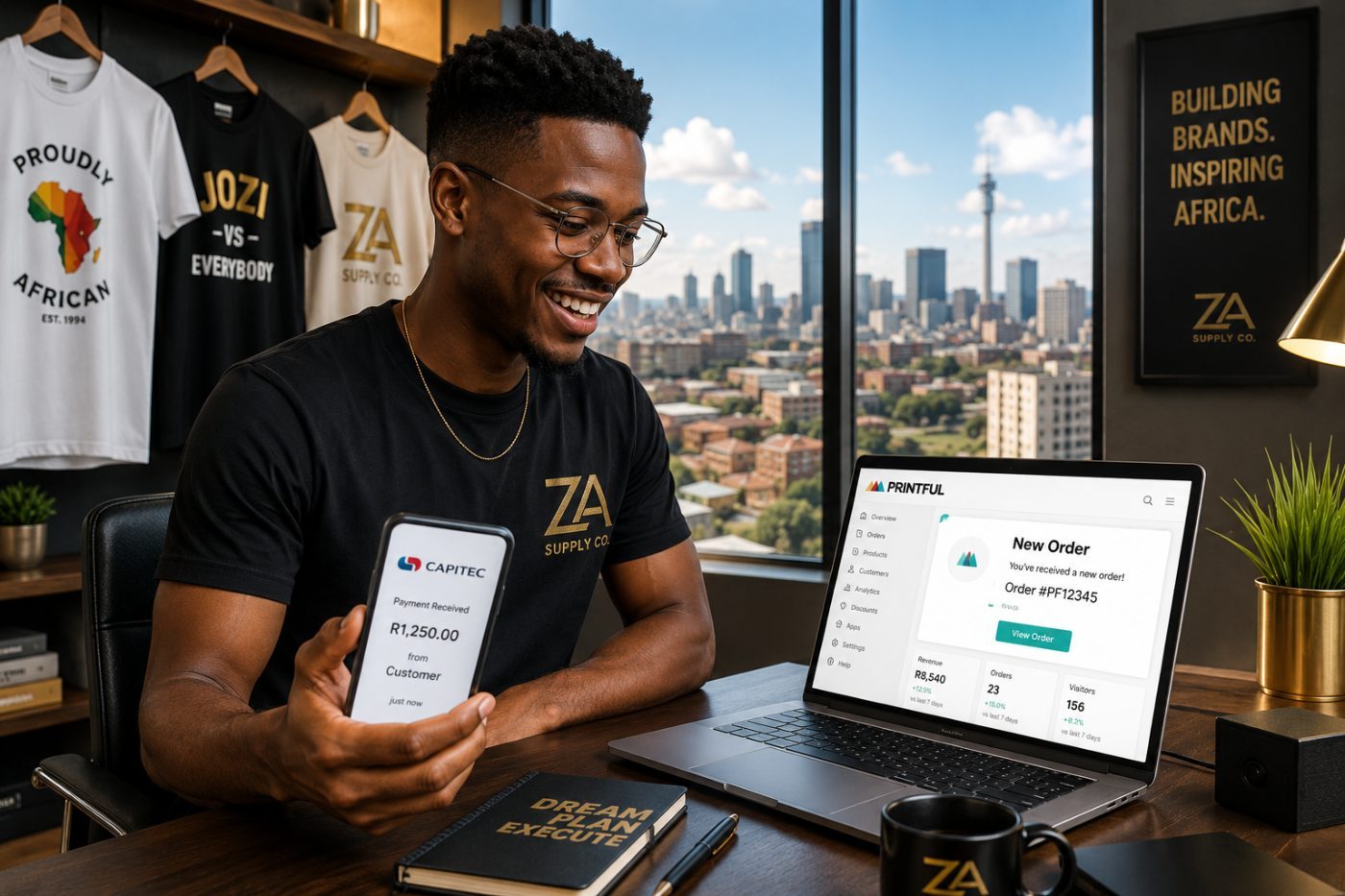
Let me give you a reality check.
The "standard" advice for starting a print-on-demand business is: "Create a Shopify store, install Printful, and start selling!"
That advice gets you nowhere in South Africa.
Why? Shipping from overseas suppliers takes 2-4 weeks. Customs holds packages hostage. Customers expect Takealot-speed delivery. You will get refund requests, bad reviews, and a damaged reputation.
Here is what actually works in South Africa in 2026: local suppliers, local shipping, and a pricing strategy that accounts for the cost of doing business.
I have helped three people in Cape Town and Johannesburg launch profitable POD stores in the past year. Here is exactly what they did.
Step 1: Set Up Your Store with Shopify
Shopify is the best platform for POD in South Africa. It integrates seamlessly with print-on-demand apps and payment gateways.
Exactly what to do:
Go to shopify.com/za and sign up.
Use the 3-day free trial, then the introductory rate of $1 per month for the first 3 months.
Pick a free theme — Dawn is clean and mobile-optimized.
Skip the complex customizations. Just get the store live.
Cost breakdown:
Shopify Starter Plan (first 3 months): ~R81/month
Domain name: ~R150/year
Total upfront cost: ~R230
Step 2: Find a South African POD Supplier
This is where most beginners fail. They use international suppliers and lose money on shipping and returns.
Your options for local suppliers:
Option 1: Inktweb (Cape Town-based)
This is the best supplier for South Africans. Full transparency on pricing — the cost per item includes the base product, printing, and packaging.
Product range: T-shirts, hoodies, mugs, caps, phone cases, notebooks, tote bags, golf shirts
Key advantage: Only charges you the cost of printing — no monthly subscriptions
Shipping: Local delivery from Cape Town to Johannesburg takes 2-5 business days
Pro tip: Request a sample before you start selling. Inktweb will send you one to check quality. Add the sample cost to your business expenses.
Option 2: Stokkies (South Africa-based)
Also offers a wide range of customizable products. Compare Inktweb and Stokkies pricing before committing.
Option 3: International platforms (Printful, Printify)
Use these ONLY if you are selling to US/European customers. For South African buyers, the shipping delays will kill your business.
Step 3: Connect Your Supplier to Shopify
For Inktweb:
Install the Inktweb app from the Shopify App Store.
Connect your store to the app.
Sync products to your Shopify store — or create custom products within the app.
When a customer places an order, the order automatically goes to Inktweb for fulfillment.
For Printful (if you choose to sell internationally):
Install the Printful app from the Shopify App Store.
Create an account and connect it to your Shopify store.
Browse Printful's catalogue, customize products, and push them to your store.
Printful handles production and shipping.
Pro tip: If you use Printful for international orders, clearly state shipping times on your product pages. South African customers expect transparency.
Step 4: Set Up Payments for South African Customers
Here is the headache: Shopify Payments is NOT available in South Africa. You must use a third-party payment gateway.
Your options:
PayFast: Best for general use. Most widely used in South Africa.
Paystack: Best for startups, easy onboarding. Developer-friendly, fully localised for African markets.
Peach Payments: Best for high-volume retailers. Lower percentage fees.
Exactly what to do:
Sign up with your chosen provider (I recommend PayFast or Paystack).
Provide your South African ID, proof of address, and business bank account.
Connect the gateway to your Shopify store via the "Payments" section.
Test with a small transaction before going live.
Important: Shopify charges an additional transaction fee (0.2%–2.0% by plan) when you use a third-party gateway. Factor this into your pricing.
Step 5: Pricing Strategy That Actually Works
Do not just add a 50% markup and hope for the best. South African customers compare prices and will leave if you are overpriced.
Pricing formula:
(Product base cost + Shipping + Print fee) x 2.5 + VAT
Example for a t-shirt:
T-shirt base cost: R120
Printing cost: R80
Packaging: R10
Shipping: R40
Shopify + payment fees: ~R30
Total cost: R280
Your selling price (2.5x): R700
Your profit per sale: R420
Pro tip: Start with your prices slightly lower to get early reviews and social proof. Once you have 20-50 sales, increase prices.
Step 6: Find Your Niche — Do Not Sell Everything
Here is where most beginners fail. They open a "general store" and sell 500 random products. Nobody buys because nobody trusts a store that sells t-shirts and mugs and phone cases all mixed together.
Niche ideas for South Africa:
South African pride: T-shirts with local slang, cities, or landmarks
Outdoor and adventure: Hiking, camping, safari-themed apparel
Sports fans: Rugby, cricket, or football-inspired designs
Local artists: Collaborate with South African artists to sell their designs
Pet lovers: Dog and cat-themed products for South African pet owners
How to validate your niche:
Search your niche on Facebook Marketplace and Bidorbuy.
Search Instagram and TikTok using relevant hashtags.
Check Google Trends for South Africa.
Step 7: Marketing — Where to Find Customers
Free marketing channels:
Facebook Marketplace: List your products directly. Free and highly effective in South Africa.
Instagram and TikTok: Post content showcasing your designs. Short-form video works best.
WhatsApp Status and Groups: South Africa is a WhatsApp-first country. Share your products in relevant groups.
Takealot and Bidorbuy: Some POD sellers cross-list products on these marketplaces for extra visibility.
Paid marketing (when you have budget):
Facebook and Instagram Ads: South Africa has lower CPMs than Western markets — your ad budget goes further.
TikTok Ads: Younger South Africans discover products through short-form content.
Collaborations: Partner with South African influencers or micro-influencers in your niche.
Pro tip: Start with free channels to validate your products. Once you have a product that sells, put R1,000+ behind Facebook ads to scale.
Step 8: Handle Delivery and Returns
South African customers expect fast delivery. Here is how to deliver:
Shipping options:
The Courier Guy: Reliable and widely used in South Africa.
PostNet: Offers national shipping with tracking.
PUDO: Parcel pickup points — cheaper for customers.
Returns policy:
Offer 14-day returns for defective or damaged products.
For customer mistakes (wrong size, changed mind), charge a restocking fee.
Make your returns policy clear on your website.
The Hard Truth
Print-on-demand in South Africa is not a get-rich-quick scheme. It takes work, patience, and learning from mistakes.
Your biggest challenge will be shipping. South African customers are used to Takealot's 1-2 day delivery. You cannot match that with POD. So be transparent: list shipping times clearly, offer tracking numbers, and under-promise and over-deliver on delivery times.
The margins are smaller than international POD, but the market is underserved. Most South African POD stores are low-quality. If you invest in good designs and quality products, you will stand out.
Your 5-Step Action Plan
Pick a niche — one specific category, not 500 random products
Set up your Shopify store — sign up for the $1 trial
Find a local supplier — Inktweb or Stokkies
List 10-20 products — use quality mockups and clear descriptions
Start marketing — WhatsApp, Facebook Marketplace, Instagram, TikTok
Your Call to Action
Open your phone right now. Go to shopify.com/za. Sign up for the $1 for 3 months trial. Pick one niche. Research Inktweb's catalog. List five products.
Then DM me or drop a comment below: what niche are you starting with? I will personally reply with design ideas and marketing tips.
The South African e-commerce market is growing. Your store could be next. 🇿🇦