Crypto Investing in Africa: Safety & Regulations
Discover the latest crypto regulations in Africa and learn how to invest safely in 2026. Find out the risks and benefits of crypto investing and get ahead of the curve, but beware: the crypto market can be volatile, Read now to avoid costly mistakes
By Obed Avorlenu · · 10 min read
IMPORTANT DISCLAIMER
This guide is for educational and informational purposes only. Cryptocurrency regulations, exchange policies, and security practices are subject to change. Always verify current regulations in your country before investing. The author and VectricEarn are not responsible for any financial losses. This is not financial advice.
The 2026 Reality: Africa Is Now Regulated
In 2026, African regulators have moved beyond "policy design" to active implementation, focusing on institutional credibility and investor protection. Eight African countries have now implemented crypto-specific regulations, with South Africa, Nigeria, and Kenya leading a continental push that's reshaping how digital assets operate across the world's fastest-growing crypto market.
Sub-Saharan Africa received over $205 billion in on-chain crypto value between July 2024 and June 2025, a 52% year-on-year jump. Africa now has around 75 million crypto wallet users — the fastest regional growth rate in the world.
Here is what you need to know about regulations in the major African markets.
🇳🇬 Nigeria: New Executive Order (July 2026)
On July 17, 2026, President Bola Tinubu signed the Presidential Executive Order on Virtual Assets Coordination, 2026 — a landmark framework that takes immediate effect.
What the New Framework Does
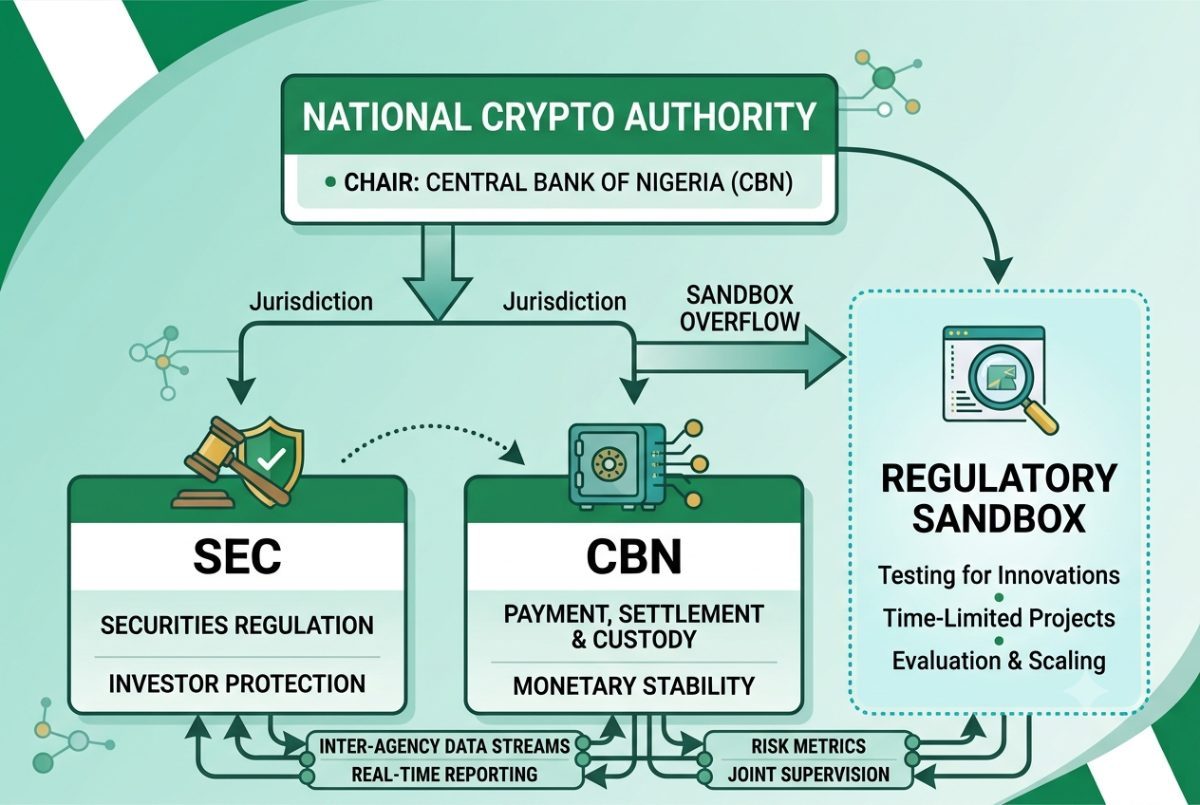
Establishes a Virtual Asset Council chaired by the Central Bank of Nigeria (CBN), with the Nigeria Revenue Service (NRS) and Securities and Exchange Commission (SEC) serving as vice-chairs.
Creates a Virtual Asset Office within the CBN to coordinate information sharing, applications, and reporting.
Clarifies jurisdiction:
Virtual assets classified as securities \rightarrow regulated by the SEC
Payment, settlement, custody, and related services for non-security virtual assets \rightarrow supervised by the CBN
Launching a regulatory sandbox where eligible operators can test virtual asset products and blockchain-based solutions under regulatory supervision.
Tax policy coming from the Nigeria Revenue Service to clarify the application of Nigeria's tax laws to crypto.
Virtual Assets White Paper outlining the country's long-term policy direction for the sector.
What This Means for You
Before the Order:
Fragmented regulation
Unclear which regulator oversees what
No regulatory sandbox
Unclear tax treatment
After the Order:
Coordinated oversight
Clear jurisdiction (SEC vs CBN)
Testing environment for new products
Tax policy forthcoming
The bottom line: Nigeria is serious about regulating crypto. This creates a safer environment for investors — but also means exchanges and platforms must comply with licensing requirements.
🇿🇦 South Africa: The Benchmark
South Africa is currently viewed as a benchmark for integrating crypto assets into existing financial systems. Crypto assets are officially regulated as "financial products."
Key Developments in 2026
310 licenses approved by the Financial Sector Conduct Authority (FSCA) from 533 applications by the end of March 2026.
Key license statistics (as at 31 March 2026):
533 total applications received
310 approved
17 declined
124 voluntarily withdrawn
Joint communication from SARB and FSCA (May 2026) clarifying that crypto assets used for domestic payments are not considered payments under the National Payment System Act — they are not legal tender.
Draft Capital Flow Management Regulations, 2026 propose to bring crypto assets expressly within South Africa's exchange control framework.
Key proposal: Crypto assets are excluded from the definition of "currency" and "foreign currency" but included in the definition of "capital."
New category proposed: "Authorised Crypto Asset Service Provider" (ACASP) — similar to the existing authorised dealer regime for foreign currency.
What This Means for You
Only licensed CASPs can operate legally in South Africa
Crypto transactions above a certain threshold will require ACASP involvement
Anti-money laundering (AML) obligations apply
SARB reporting requirements under the Crypto Asset Reporting Framework (CARF)
Crypto is regulated, not banned — transactions will be highly regulated but permitted
🇰🇪 Kenya: The Emerging Framework
Kenya shows promise through legislative progress and industry engagement. Kenyan users acquired around $19 billion in crypto assets between July 2024 and June 2025, making Kenya the fourth largest crypto market on the continent. Over six million Kenyans now use digital assets.
Key Developments in 2026
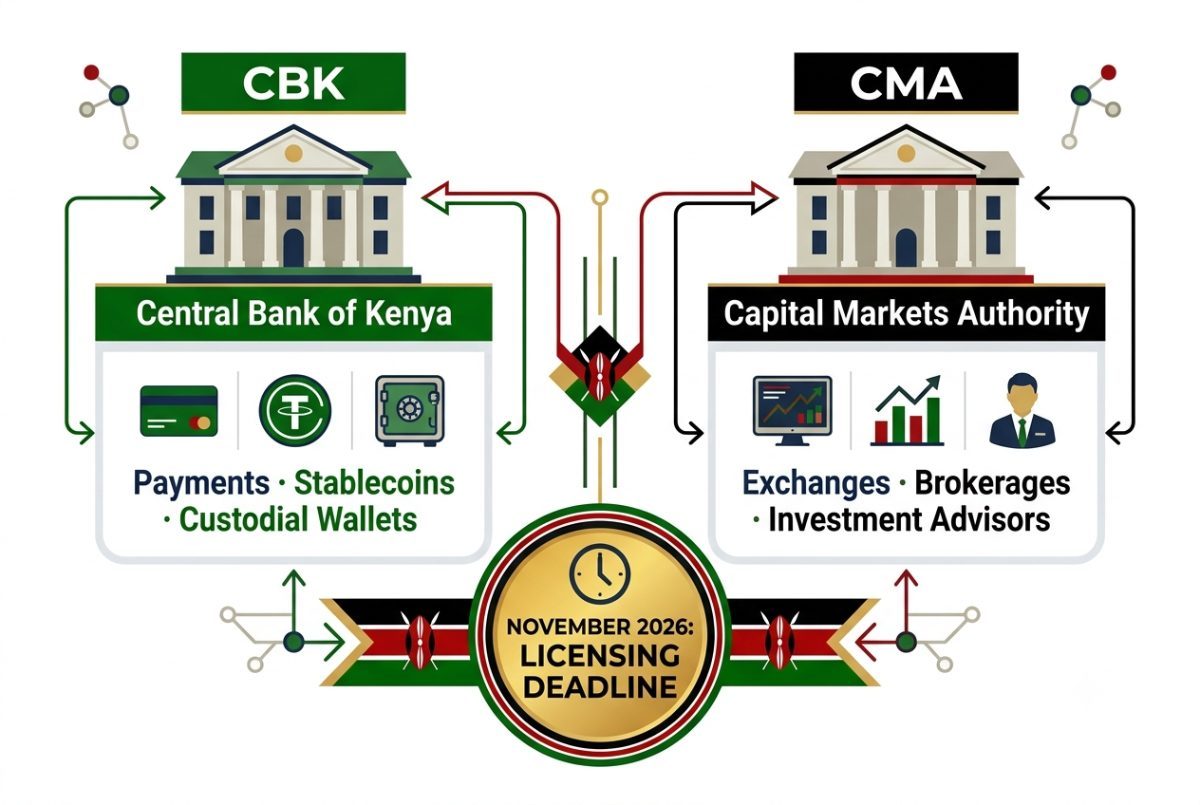
Virtual Asset Service Providers Act (2025) established a dual-authority model:
Central Bank of Kenya (CBK) oversees payments, stablecoins, and custodial wallets
Capital Markets Authority (CMA) regulates exchanges, brokerages, investment advisors, and tokenization platforms
At the time the regulations were being implemented, CBK and CMA stated that no VASPs had yet been licensed under the new framework.
Kenya's parliament has directed the Blockchain Association of Kenya (BAK) to draft the country's first comprehensive cryptocurrency regulation bill.
Draft VASP Regulations 2026 outline licensing requirements for exchanges, wallet providers, and stablecoin issuers. Industry groups warn the proposed capital requirements could price startups out of licensing.
CMA seeking blockchain analytics platform to track digital asset transactions, investigate suspicious activities, and monitor regulatory compliance — capable of tracking Bitcoin, Ethereum, and at least 20 other blockchains.
What This Means for You
Crypto is legal but regulated in Kenya
The 3% tax on crypto transfers and exchanges remains in effect
By November 2026, only licensed platforms can operate
The CMA is actively monitoring transactions and unlicensed platforms
🔐 Choosing the Right Wallet: Security First
In countries where currencies have lost significant purchasing power (Nigeria, Ethiopia, Zimbabwe, and others), people who held savings on centralized exchanges have sometimes found their accounts frozen or withdrawals delayed.
Holding your own keys means no platform can block access to your funds.
Understanding Your Wallet Options
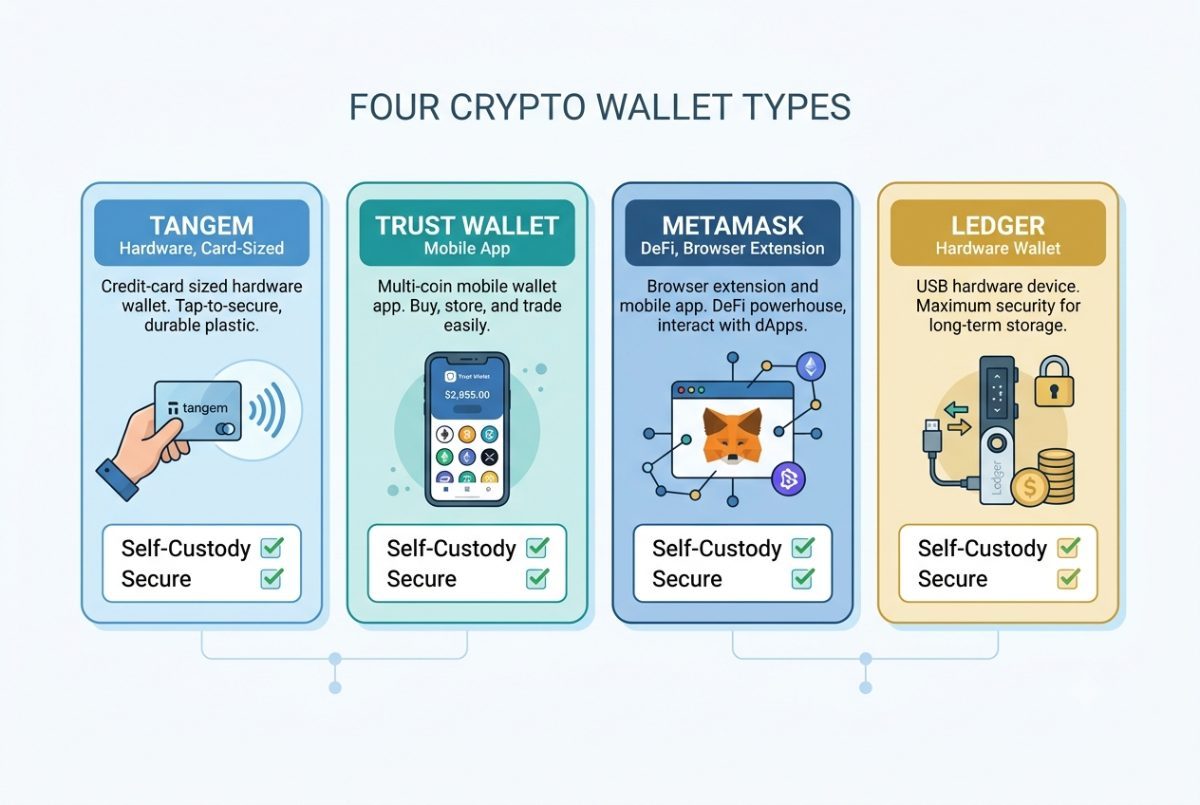
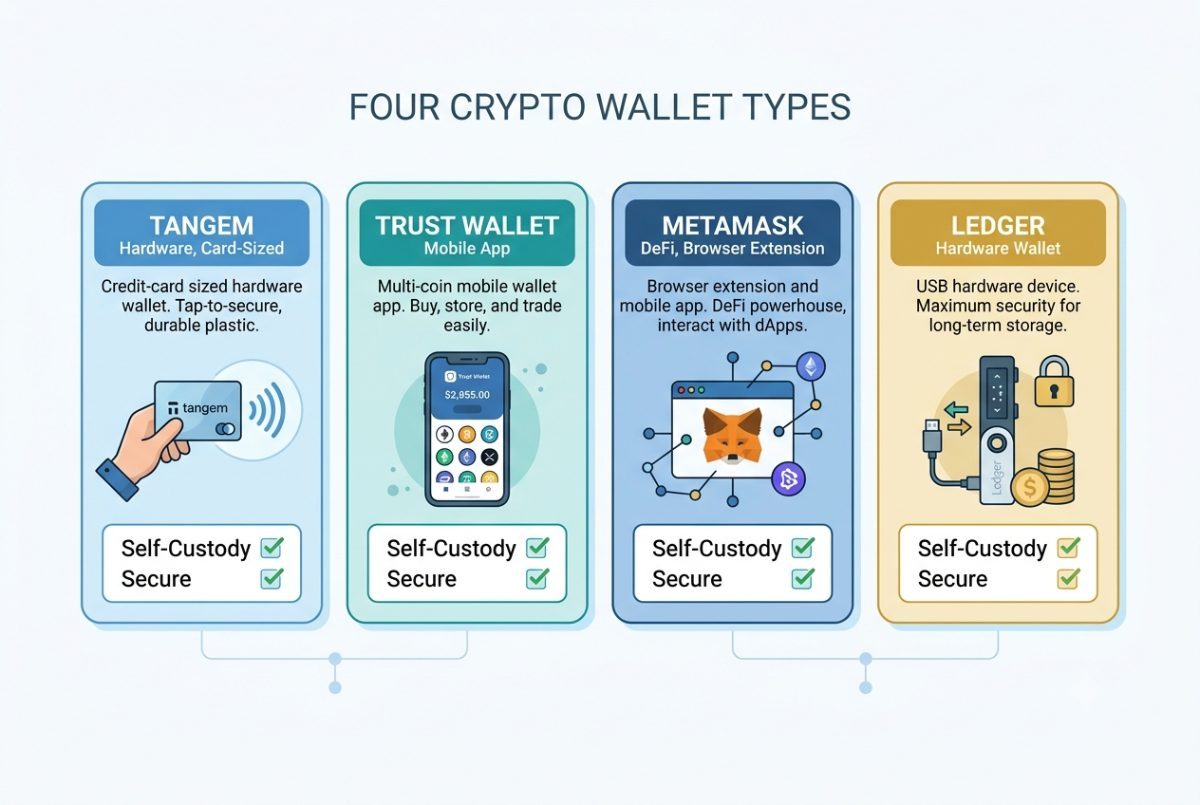
Hardware Wallet (Examples: Tangem, Ledger, Trezor)
Security: Highest
Best For: Long-term storage, large financial amounts
Mobile Wallet - Non-Custodial (Examples: Trust Wallet, MetaMask)
Security: Medium-High
Best For: Daily use, peer-to-peer (P2P) trading, DeFi
Exchange Wallet - Custodial (Examples: Binance, Yellow Card, Luno)
Security: Low-Medium
Best For: Active trading, holding small operational amounts
Top Recommendations for Africans
Tangem Wallet — Best Overall for Africa Tangem is a credit-card-sized hardware wallet that works without a battery or USB port. It offers seedless setup, crypto swaps, native staking, and crypto price quotes directly in the app. Two-card sets sell for $54.90, with the extra card serving as a physical backup. Independently audited by Kudelski Security, Riscure, and Cure53.
Trust Wallet — Best Mobile Wallet Popular mobile wallet for everyday crypto use. Broad token support and low barrier to entry — the app is free.
MetaMask — Best for DeFi Widely used wallet for DeFi and Web3 access.
Ledger — Best for Maximum Security Hardware wallet prioritizing security. Nano X is the top choice for maximum security.
Where to Keep Your Crypto
Less than $100: Mobile wallet (Trust Wallet)
$100 – $1,000: Mobile wallet with strong security settings enabled
$1,000 – $10,000: Hardware wallet (Tangem, Ledger)
$10,000+: Hardware wallet combined with a multi-signature setup
⚠️ The Risks: What Can Go Wrong
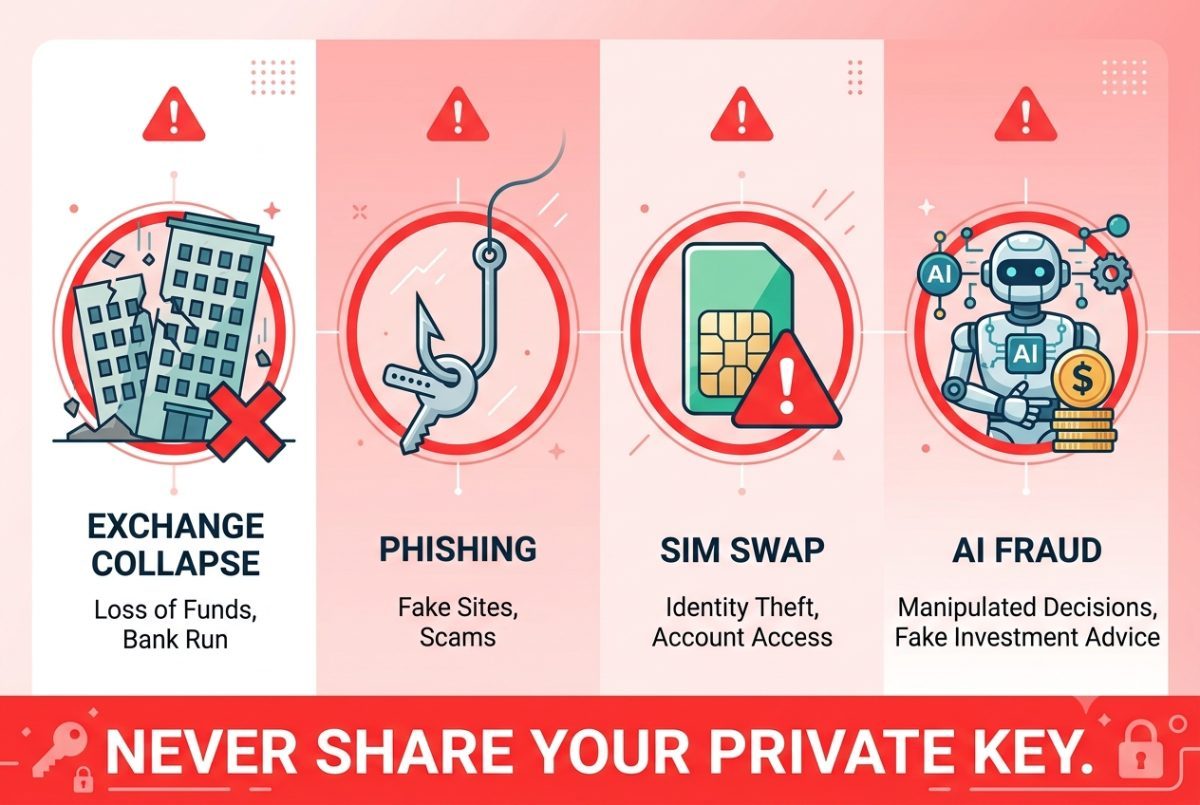
Risk 1: Exchange Collapse and Freezes
The problem: Centralized exchanges can freeze accounts, delay withdrawals, or collapse entirely. In Africa, where currencies have lost significant purchasing power, people who held savings on centralized exchanges have sometimes found their accounts frozen.
The solution:
Use self-custody wallets for long-term storage.
Only keep what you need for immediate trading on exchanges.
Diversify across multiple platforms if you are actively trading.
Use regulated exchanges only (always check licensing).
Risk 2: Scams and Ponzi Schemes
The numbers are staggering:
A cryptocurrency Ponzi scheme operating across 17 countries including Kenya defrauded over 100,000 people and generated $562 million in losses.
Nigeria's Senate uncovered an estimated ₦1.3 trillion fraud linked to the CBEX Ponzi scheme. Over 1,200 victims were identified in Lagos and Ogun states alone.
CBEX promised a 100% return on investment through "AI trading" — victims were instructed to buy USDT on Bybit and transfer funds to private wallets, bypassing banking red flags.
The scheme obtained a SCUML certificate from the EFCC and used it as a false "badge of clearance" to deceive victims.
Ghanaians lost GH¢3.4 million to online investment scams in the first six months of 2026 alone, with 352 cases recorded.
Common scam patterns to watch for:
Promises of "guaranteed" or "unrealistically high" financial returns.
Earnings that depend primarily on recruiting new participants into the ecosystem.
Heavy social media hype and strong referral incentives.
Aggressive advertising with fast, short-term payouts to build trust before collapsing.
Messages like: "Send me ₦50k, I'll give you ₦100k in 24 hours" — these are always Ponzi schemes.
The SEC's Warning: "Be wary of schemes promising unusually high or guaranteed returns. Avoid schemes where earnings depend primarily on recruiting others."
Risk 3: AI-Powered Fraud
The cybersecurity chiefs of the Five Eyes intelligence alliance recently warned that frontier AI models will "fundamentally transform both offensive and defensive cyber capabilities" within months, not years.
AI-assisted smart contract exploits now cost attackers as little as $1.22 per contract.
AI-enabled scams extract 4.5 times more money per incident than traditional cyber methods.
Impersonation attacks surged 1,400% year-on-year in 2025.
Crypto accounted for 88% of all detected deepfake fraud cases globally.
Risk 4: SIM Swap Attacks
The problem: Scammers can trick your mobile network provider into transferring your phone number to a SIM card they control. Once they control your number, they intercept SMS verification codes to breach your crypto accounts.
The solution:
Set up a unique SIM card PIN directly with your provider.
Use Authenticator apps (like Google Authenticator or Authy) instead of SMS for 2FA.
Contact your network provider immediately if your phone signal drops or stops working unexpectedly.
Risk 5: Phishing Attacks
The problem: Scammers send fraudulent emails, SMS, or direct messages pretending to be from popular exchanges, tricking you into clicking links or exposing your private keys.
The solution:
Never share your private key or seed phrase with anyone under any circumstances.
Always type the exchange URL directly into your browser; never click links inside emails.
Check the sender's exact email address carefully for subtle spelling variations.
Enable multi-factor authentication across all active accounts.
🔍 How to Verify a Platform Is Legitimate
The Checklist
Before depositing any money, ask yourself:
Is the platform officially licensed to operate in your specific country?
Does the domestic regulator's website list it as an approved entity?
Has the SEC or FSCA issued any active warnings against it?
Does the business maintain a verifiable physical address and accessible customer support?
What do independent community reviews say? (Ignore paid social media hype)
Does it promise "guaranteed" or "unusually high" returns? \rightarrow Red flag
Does it strongly encourage or force recruiting others to unlock earnings? \rightarrow Red flag
Where to Verify Platforms
Nigeria: Securities and Exchange Commission (SEC Nigeria) \rightarrow Check the official SEC website for public warnings and licensed entity lists.
South Africa: Financial Sector Conduct Authority (FSCA) \rightarrow Verify the platform on the FSCA public register of licensed CASPs.
Kenya: Capital Markets Authority (CMA Kenya) \rightarrow Check the official CMA directory for approved digital asset services.
Ghana: Securities and Exchange Commission (SEC Ghana) \rightarrow Review SEC warning boards and check their registry of licensed entities.
Recent Regulatory Warnings
Nigeria SEC officially warned the public against AURUM BOT and ModMount for operating as fraudulent Ponzi schemes.
Ghana SEC issued warnings against YEPBIT Exchange and BONCHAT — stating both platforms are not licensed to operate.
Ghana Cyber Security Authority highlighted 352 online investment fraud cases costing citizens GH¢3.4 million in the first half of 2026 alone.
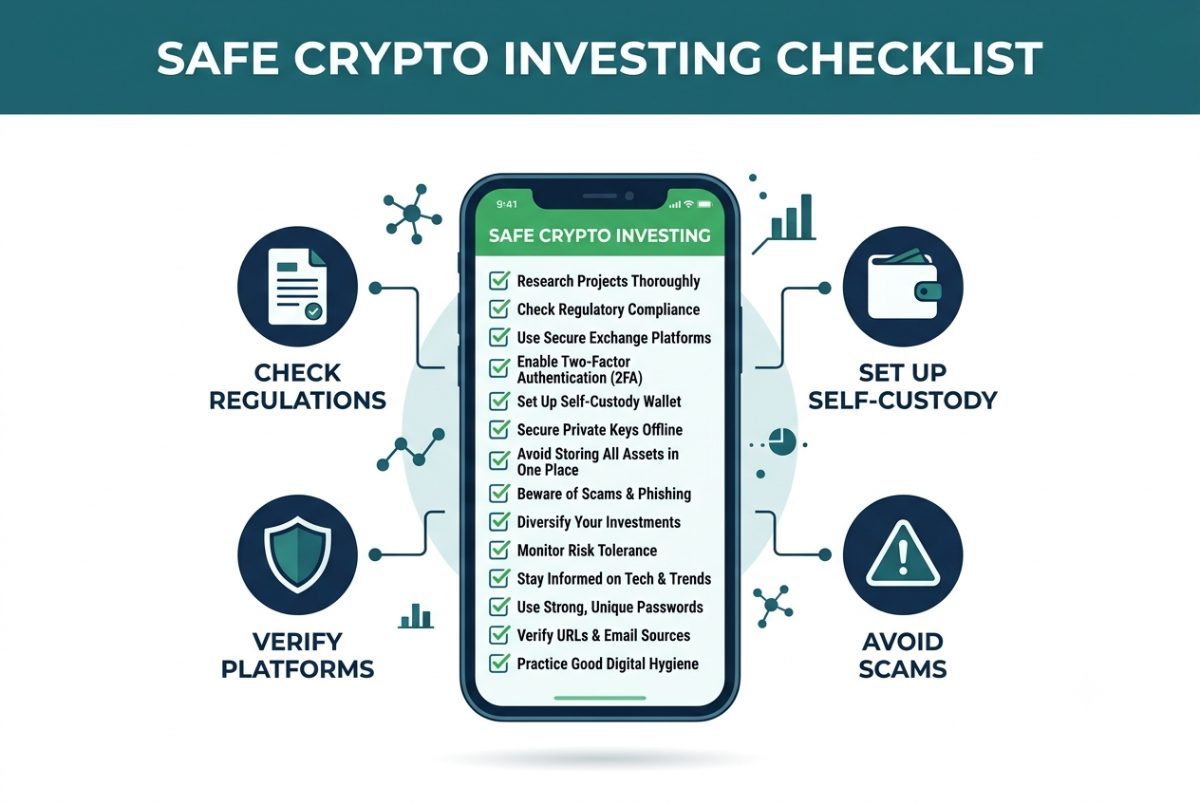
✅ Your Safe Crypto Investing Checklist
Before You Invest
Check your country's current regulations — Is crypto legal? Are exchanges actively licensed?
Choose regulated platforms only — Cross-verify registration status on the regulator's portal.
Set up a secure self-custody wallet — Use trusted solutions like Tangem, Trust Wallet, or Ledger.
Enable 2FA — Secure accounts using an authenticator app rather than standard SMS.
Set a SIM card PIN — Add an immediate layer of defense against SIM swap attacks.
While You Invest
Never invest more money than you can comfortably afford to lose.
Diversify your risk — Do not pool all your capital into one coin or a single exchange.
Verify every third-party platform independently before depositing funds.
Never expose your private key or backup seed phrase to any person or website.
Remain completely suspicious of "guaranteed" returns — they do not exist in real markets.
After You Invest
Move your trading profits over to self-custody — Do not leave large balances sitting on exchanges.
Actively track your digital investments — Use a secure portfolio tracker.
Keep clean financial records — Prepare for tax obligations as frameworks roll out.
Stay informed — Regulatory rules change fast. Regularly follow updates from your local regulator.
Your One Action for Today
Follow these steps right away to secure your digital footprint:
Open your smartphone app store.
Download a proven self-custody wallet app (such as Tangem, Trust Wallet, or MetaMask).
Write down your unique backup seed phrase on physical paper. Store it in a secure location.
Turn on multi-factor authentication (2FA) across all your current exchange accounts.
Call your mobile network operator or open your settings to set up a private SIM card PIN.
Crypto is officially regulated across Africa. Invest legally. Store securely. Avoid the scams.
Start today and protect your financial future.
Last Verified: July 2026